Rebuilt Transmission Price Guide: Costs, Options & What to Compare
A transmission failure is one of the most significant mechanical issues a vehicle owner can encounter. When faced with slipping gears, harsh shifts, or complete loss of drive, most drivers immediately ask two questions: How much will a rebuilt transmission cost, and is it worth fixing?
Because a quote depends heavily on vehicle design, damage severity, parts availability, and shop labor rates, there is no single universal price tag. In 2026, a standard transmission rebuild generally ranges anywhere from $1,800 to $4,500 for common passenger vehicles, while specialized, high-performance, or luxury transmissions can easily exceed $6,000 to $10,000+.
This guide outlines how transmission rebuild pricing works, what factors drive up total repair bills, how rebuilds compare to other repair paths, and what to verify before approving a quote.
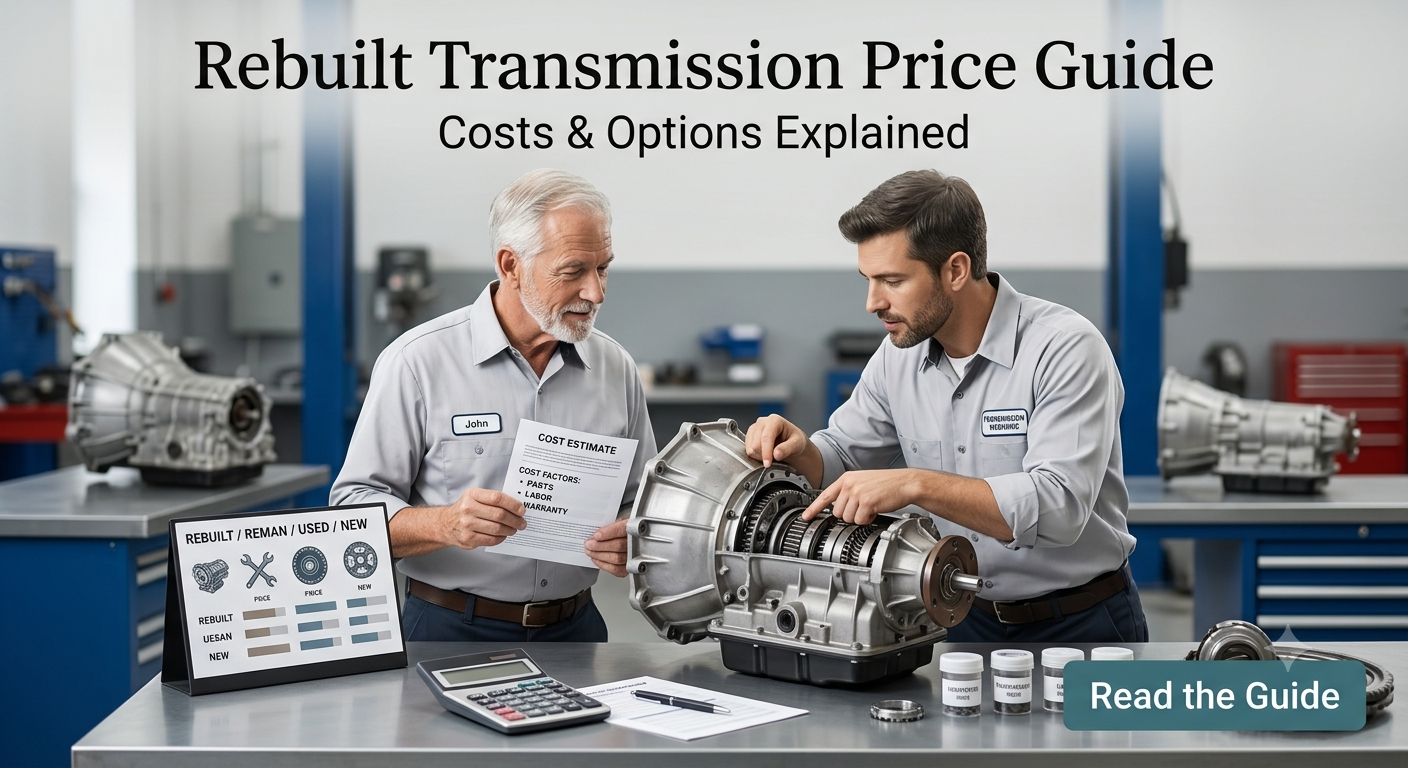
Rebuilt Transmission Price Guide: What It Costs and What Affects the Price
A transmission failure is one of the most significant mechanical issues a vehicle owner can encounter. When faced with slipping gears, harsh shifts, or complete loss of drive, most drivers immediately ask two questions: How much will a rebuilt transmission cost, and is it worth fixing?
Because a quote depends heavily on vehicle design, damage severity, parts availability, and shop labor rates, there is no single universal price tag. In 2026, a standard transmission rebuild generally ranges anywhere from $1,800 to $4,500 for common passenger vehicles, while specialized, high-performance, or luxury transmissions can easily exceed $6,000 to $10,000+.
This guide outlines how transmission rebuild pricing works, what factors drive up total repair bills, how rebuilds compare to other repair paths, and what to verify before approving a quote.
What Is a Rebuilt Transmission?
A transmission rebuild (often referred to as a bench rebuild) is the process of restoring your vehicle’s existing transmission assembly rather than buying a completely new unit from the factory.
Instead of replacing the entire outer housing and every internal gear, a technician removes your transmission, teardowns its internal assemblies, cleans the components, replaces failed or worn parts, reassembles the unit with new seals and friction materials, and reinstalls it into the vehicle.
+-----------------------------------------------------------------------+
|                       THE REBUILD PROCESS                             |
|                                                                       |
|  [Vehicle Diagnostic] ──> [Removal & Teardown] ──> [Cleaning & Inspection] |
|                                                                 │     |
|  [Reinstallation & Road Test] <── [Reassembly & Bench Test] <───┘     |
|                                  (New Seals, Clutches, Friction)      |
+-----------------------------------------------------------------------+
The Typical Rebuild Steps
-
Removal: The transmission is unbolted and removed from the engine bay or chassis.
-
Teardown & Inspection: The shop disassembles the unit to inspect hard parts (gears, shafts, pump, drums) and soft parts (clutches, bands, seals, gaskets).
-
Cleaning & Parts Replacement: All reusable parts are solvent-cleaned. Worn or damaged parts are replaced with new or reconditioned components.
-
Reassembly & Testing: The transmission is rebuilt to original operational tolerances with new seals, friction plates, and a replacement or remanufactured torque converter.
-
Reinstallation & Adaptation: The unit is reinstalled, filled with fresh fluid, dynamically tested, and reprogrammed (relearned) via diagnostic software if required.
Rebuilt Transmission Cost in 2026
Transmission rebuild pricing varies considerably across different vehicle classes and transmission technologies. The table below outlines general cost ranges based on published industry benchmarks in 2026.
|
Transmission / Vehicle Type |
Typical Rebuild Range (Installed)* |
Key Cost Drivers |
|---|---|---|
|
Mainstream Automatic (4 to 6-Speed) |
$1,800 – $4,500 |
Widespread parts availability, straightforward bench labor. |
|
Modern Multi-Speed (8 to 10-Speed) |
$3,200 – $5,500 |
High solenoid counts, complex valve bodies, tight tolerances. |
|
CVT (Continuously Variable) |
$2,500 – $6,500+ |
Specialized belts/pulleys, high replacement component costs. |
|
DCT (Dual-Clutch Transmission) |
$3,500 – $7,000+ |
Complex mechatronic units, dual-clutch pack assemblies. |
|
Truck / Heavy-Duty (4WD/AWD) |
$3,000 – $6,000+ |
Heavier assemblies, transfer case removal, heavy-duty clutch kits. |
|
Luxury / European / Performance |
$4,000 – $10,000+ |
Specialized diagnostic tools, expensive proprietary parts, elevated labor rates. |
*Note: Figures reflect estimated total installed costs (parts plus labor). Actual quotes depend on specific vehicle make, model year, damage severity, and regional labor rates.
What Makes a Transmission Rebuild More Expensive?
When two vehicle owners receive quotes that differ by thousands of dollars, the variance usually comes down to specific design and failure factors:
-
Transmission Architecture: Older 4-speed or 6-speed automatic transmissions are mechanically simpler and easier to source parts for than modern 8-, 9-, or 10-speed units.
-
CVT and DCT Complexity: Continuously Variable Transmissions (CVTs) rely on high-tension steel belts and variable pulleys, while Dual-Clutch Transmissions (DCTs) feature electronic mechatronic modules. Rebuilding these requires specialized training and expensive proprietary replacement kits.
-
Drivetrain Layout (AWD vs. FWD): Front-wheel-drive vehicles with tight engine bays or all-wheel-drive (AWD) vehicles with transfer cases require extra labor hours just to drop and reinstall the unit.
-
Extent of Internal Hard-Part Damage: Replacing soft parts (clutches, bands, seals) is standard. However, if a failure causes metal shavings to ruin hard parts (sun gears, planetary gear sets, input shafts, or pump housings), material costs jump dramatically.
-
Electronics & Valve Body Failure: Modern transmissions rely on electronic solenoids and hydraulic valve bodies. Replacing a damaged valve body or mechatronic control unit can add $500 to $1,800 to the bill.
-
Labor Rates & Location: Specialized transmission technicians charge anywhere from $90 to $200+ per hour depending on region and shop type (independent shop vs. dealership).
-
Software Programming: Many modern transmissions require computer re-flashing or solenoid strategy code registration after installation so the Engine Control Unit (ECU) recognizes the rebuilt transmission.
Parts vs. Labor Breakdown
Labor often makes up 40% to 60% of a total transmission rebuild invoice because of the time required to remove, tear down, clean, reassemble, and reinstall the assembly.
Cost Component           What It Typically Includes
------------------------------------------------------------------------------------
Rebuild Banner Kit       Clutches, friction plates, steel bands, O-rings, gaskets, seals.
Hard Parts               Planetary gears, shafts, drums, pump housing (if damaged).
Torque Converter         New or remanufactured torque converter (almost always replaced).
Electronics              Shift solenoids, pressure sensors, wiring harness, valve body.
Fluids & Filters         Synthetic transmission fluid, internal filter, pan gasket.
Removal & Install Labor  8 to 14+ hours of shop labor to pull and reinstall the unit.
Bench Rebuild Labor      4 to 8 hours to teardown, clean, rebuild, and set clearances.
Programming / Fluids     Computer adaptation, fluid fill, flush cooler lines, road testing.
Rebuilt vs. Remanufactured vs. Used vs. New
When exploring replacement options, you will encounter four distinct paths. Understanding the differences helps prevent overpaying or buying under-protected units.
|
Option |
How It Works |
Primary Advantage |
Main Consideration |
|---|---|---|---|
|
Rebuilt |
Local shop teardowns and restores your existing unit, replacing broken/worn components. |
Often more cost-effective; keeps the original housing. |
Quality depends entirely on the individual technician’s skill. |
|
Remanufactured |
Unit is built in a specialized factory setting to factory tolerances with all wear parts replaced. |
High consistency; rigorous dyno testing; nationwide warranties. |
Higher upfront parts cost than a basic local rebuild. |
|
Used (Salvage) |
Taken directly from a donor or salvaged vehicle with minimal cleaning or testing. |
Lowest upfront purchase cost. |
Unknown mileage, condition, and remaining lifespan. |
|
New (OEM) |
Brand-new assembly directly from the vehicle manufacturer. |
Unused factory condition and maximum lifespan potential. |
Highest cost; often unavailable for older vehicle models. |
Rebuilt vs. Remanufactured Cost Considerations
While the terms are often used interchangeably, a remanufactured transmission is processed in a centralized factory facility. Factory remanufacturers update known OEM design flaws, inspect every casting with advanced machinery, and dyno-test completed units before shipping.
-
Local Rebuild: Typically ranges between $1,800 and $4,500 installed.
-
Factory Remanufactured: Often ranges between $2,800 and $5,500+ installed.
A remanufactured unit often carries a slightly higher price tag upfront due to freight shipping and core charges, but it frequently includes a longer, nationwide parts-and-labor warranty (e.g., 3 years / 100,000 miles).
Transmission Repair vs. Full Rebuild
Not every transmission issue requires a complete tear-down and rebuild. External or modular failures can often be repaired at a fraction of the cost.
+----------------------------------------------------------------------+
|                     DIAGNOSTIC DECISION PATH                         |
|                                                                      |
|                  [Vehicle Has Transmission Symptoms]                 |
|                                  │                                   |
|                        [Computer Scan & Inspection]                   |
|                                  │                                   |
|         ┌────────────────────────┴────────────────────────┐          |
|         ▼                                                 ▼          |
|  [External / Minor Failure]                     [Internal Failure]   |
|  - Fluid leak / filter service                   - Burnt clutches    |
|  - Single shift solenoid                         - Metal debris      |
|  - External sensor                               - Planetary slip    |
|         │                                                 │          |
|         ▼                                                 ▼          |
|  Minor Repair ($250–$1,200)                      Full Rebuild        |
|  [AutoZone Maintenance]                          [Major Service]     |
+----------------------------------------------------------------------+
Common Partial Repairs
-
Fluid and Filter Service ($150 – $350): Addresses slipping caused by low fluid levels, degraded fluid, or restricted filters.
-
Shift Solenoid Replacement ($300 – $850): Fixes specific gear-shifting errors without removing the entire transmission.
-
Transmission Cooler / Line Repair ($200 – $600): Repairs external fluid leaks or cooling line restrictions.
-
Mechatronic / Valve Body Replacement ($800 – $2,200): Addresses hydraulic or electronic control problems on modern automatic or dual-clutch systems.
Always request a full computer diagnostic scan and fluid condition check before authorizing a complete rebuild.
Hidden Costs to Ask About
To ensure an advertised estimate matches your final invoice, confirm whether these common additional items are included in the quote:
-
[ ] Diagnostic / Tear-Down Fees: Is the initial inspection fee credited toward the repair if you proceed?
-
[ ] Torque Converter: Is a new or remanufactured torque converter included in the base quote?
-
[ ] Fluid Cooler Flush or Replacement: Will the shop flush the transmission cooler lines to prevent old metal debris from contaminating the new build?
-
[ ] Synthetic Transmission Fluid: Is full fluid refill included in the estimate?
-
[ ] Computer Programming / Flash: Are module adaptation or reprogramming fees covered?
-
[ ] Core Charge: If installing a replacement unit, is there a temporary core deposit until your old transmission is returned?
-
[ ] Towing Costs: Does the shop offer free or discounted towing for major repairs?
-
[ ] Taxes and Environmental Disposal Fees: Are shop supplies and hazardous waste disposal fees itemized?
Warranty Questions to Ask Before Signing
A rebuilt transmission is only as good as the warranty backing it. Ask the service writer these specific questions before approving work:
-
How long is the coverage period? (e.g., 12 months/12,000 miles vs. 3 years/unlimited miles).
-
Does the warranty cover both parts AND labor? Some limited warranties cover replacement parts but require you to pay labor hours for re-removal.
-
Is the warranty nationwide or shop-specific? If you travel out of state, can another certified network shop perform warranty repairs?
-
Are there mandatory inspection requirements? Does maintaining the warranty require you to return for a 1,000-mile fluid check or routine filter changes?
-
Does the warranty cover fluid and incidental costs?
Signs a Quote May Need a Second Opinion
While major transmission work is expensive, you should shop around if you encounter these red flags:
-
No Itemized Breakdown: The shop provides a single lump sum without separating labor, hard parts, torque converter, and fluid charges.
-
Recommending a Rebuild Without Inspection: A shop quotes a full rebuild over the phone without connecting a diagnostic scanner or dropping the transmission pan to check for metal debris.
-
Refusal to Put Warranties in Writing: Verbal promises regarding warranty length without official paperwork.
-
Quotes Significantly Above Local Averages: An estimate that is 40% to 50% higher than competing estimates from certified transmission specialists in your area without a clear technical explanation.
Is Rebuilding a Transmission Worth It?
Deciding whether to rebuild a transmission comes down to evaluating the overall mechanical health and market value of your vehicle.
Consider Rebuilding If:                     Consider Selling / Scraping If:
----------------------------------          ----------------------------------
✓ Vehicle is paid off and in good shape.    ✗ Repair cost exceeds vehicle market value.
✓ Engine and suspension are solid.          ✗ Multiple major systems are failing.
✓ Car prices make buying a replacement      ✗ Rust or frame damage is present.
  impractical.                              ✗ Vehicle has extremely high mileage.
If your vehicle is in good condition, spending $3,000 to $4,000 on a transmission rebuild with a multi-year warranty is often far more economical than taking on a new car payment or paying current used-car market prices.
Example Quote Comparison
The following illustrative example shows how two shop quotes for the exact same vehicle can look different on paper:
|
Line Item |
Independent Transmission Shop A |
Regional Service Center B |
|---|---|---|
|
Bench Rebuild Labor |
$1,200 |
$1,400 |
|
Master Rebuild Kit & Soft Parts |
$450 |
$520 |
|
New Torque Converter |
Included ($0) |
$280 |
|
Transmission Fluid & Cooler Flush |
Included ($0) |
$150 |
|
Towing & Diagnostic Scan |
Included ($0) |
$120 |
|
Warranty Provided |
12 Months / 12,000 Miles |
36 Months / 100,000 Miles (Nationwide) |
|
Estimated Total |
$1,650 |
$2,470 |
In this scenario, Shop B charges more upfront but includes a significantly longer nationwide warranty, a fresh torque converter, and complete cooler maintenance.
Frequently Asked Questions
How much does a rebuilt transmission cost?
For standard domestic and import cars, an installed transmission rebuild typically costs between $1,800 and $4,500. Trucks, luxury vehicles, CVTs, and dual-clutch transmissions can cost between $3,500 and $7,000+.
Is rebuilding a transmission cheaper than replacing it with a new one?
Yes. Rebuilding reuses your existing metal case and undamaged internal gears, making it significantly cheaper than purchasing a brand-new OEM unit from a dealership.
What is the difference between rebuilt and remanufactured?
A rebuilt transmission is repaired locally by a technician who replaces broken or worn components. A remanufactured transmission is completely restored in a factory setting to original manufacturing specifications, often with design updates and dyno-testing included.
How long does a rebuilt transmission last?
When rebuilt by an experienced technician using quality parts, a rebuilt transmission can last 100,000 to 150,000 miles or more, provided it receives regular fluid maintenance.
Does a rebuilt transmission come with a warranty?
Yes, reputable shops provide warranties. Independent shop warranties usually range from 12 months/12,000 miles to 36 months/unlimited miles. Always ensure the warranty covers both parts and labor.
What makes transmission rebuilds so expensive?
Transmission work is highly labor-intensive. Removing the transmission, tearing down hundreds of intricate internal parts, replacing seals, reassembling to exact tolerances, and reinstalling the unit requires 10 to 20 total hours of specialized labor.
Is a used transmission cheaper than a rebuilt one?
Yes, purchasing a used transmission from a salvage yard is typically the cheapest upfront option ($800 – $1,800 installed). However, used units carry unknown history and short warranties (often 30–90 days, parts only).
Should I get multiple transmission quotes?
Yes. Getting 2 or 3 itemized quotes from specialized transmission shops lets you compare total installed prices, part quality, and warranty coverage.
Can every transmission be rebuilt?
Not always. If internal failure causes catastrophic case cracking, extreme shaft shearing, or metal melting, the core may be un-rebuildable, requiring a remanufactured or replacement unit.
Does a CVT cost more to rebuild?
Generally, yes. Continuously Variable Transmissions require specialized belts, pulleys, and calibration tools, which can raise rebuild or replacement costs compared to traditional automatic transmissions.