Guide to Know About Dental Implants Available Through the NHS
Dental implants offer a durable, long-term solution for replacing missing teeth by fusing directly with the jawbone. However, unlike routine treatments such as fillings, extractions, or basic dentures, dental implants are rarely provided under routine NHS general dental services.
Navigating NHS eligibility, treatment stages, and alternative options requires understanding how the health service evaluates complex restorative dentistry.
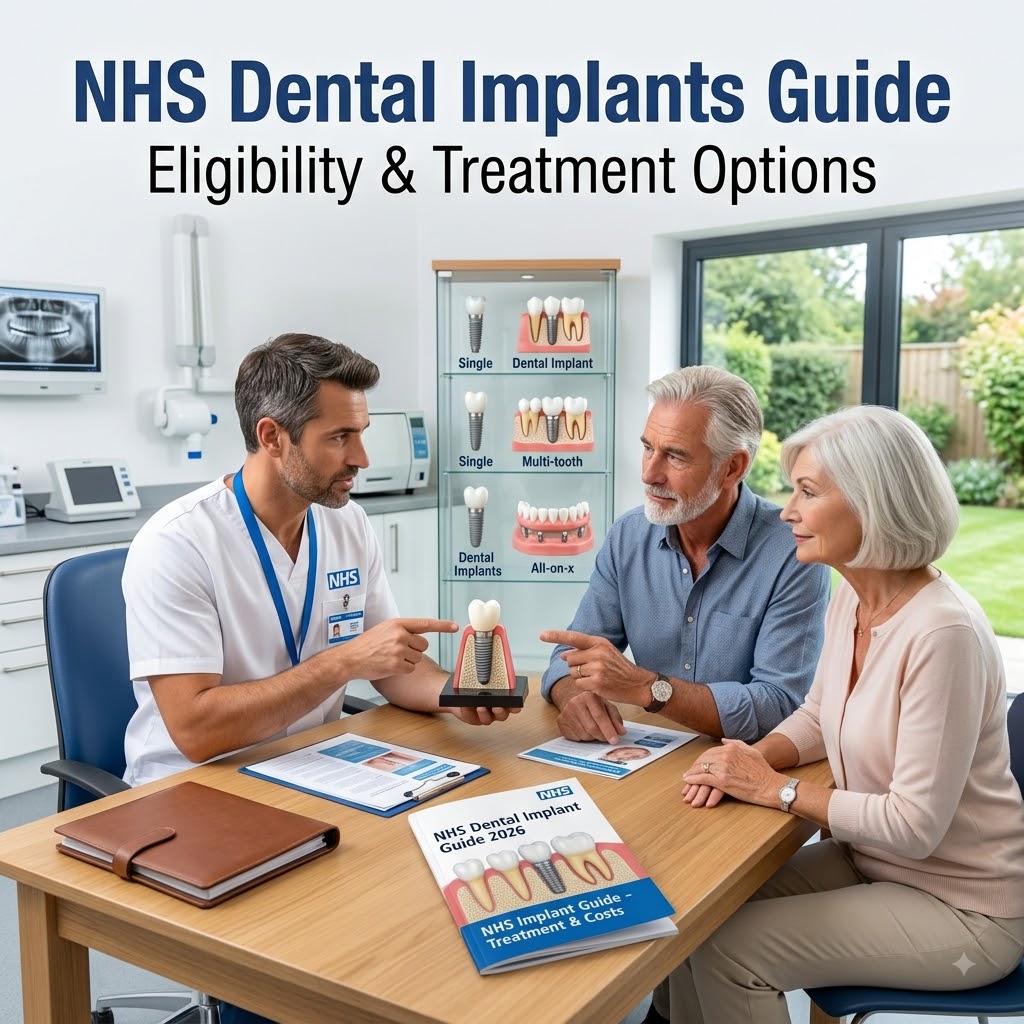
What Dental Implants Are and How They Work
A dental implant consists of a small, screw-like post made from biocompatible titanium. It is surgically inserted into the jawbone beneath the gumline to act as an artificial tooth root.
-
Osseointegration: Over several months, the surrounding jawbone grows around the titanium post, anchoring it securely in place.
-
Restoration Fitting: Once healed, an abutment (connector) is attached to the post to hold a custom-made crown (for a single tooth), a bridge (for multiple missing teeth), or a special partial/full denture (implant-retained denture).
Unlike traditional dentures, implants do not slip or click during speech and eating. Unlike dental bridges, they do not require altering or grinding down healthy adjacent teeth.
When Implants May Be Considered Through the NHS
NHS dental services operate under strict commissioning criteria. The primary purpose of NHS dentistry is to protect oral health and restore essential mouth function, rather than to improve cosmetics.
Because conventional dentures and bridges can restore basic function for most people at a much lower cost, routine tooth loss due to age, decay, or gum disease does not qualify for NHS-funded implants.
NHS funding for dental implants is strictly limited to specific medical and clinical circumstances:
                       [ NHS General Dental Practitioner ]
                                        |
                             (Referral & Assessment)
                                        |
                 +----------------------+----------------------+
                 |                                             |
     [ Specific Clinical Qualifying Cases ]         [ Routine Tooth Loss ]
                 |                                             |
   - Post-oral cancer reconstruction             - Tooth decay or wear
   - Severe facial/dental trauma                 - Standard gum disease
   - Congenitally absent teeth (Hypodontia)      - Basic denture preference
                 |                                             |
       (NHS Hospital Unit)                       (Private Dental Care)
-
Oral Cancer Reconstruction: Patients who have lost teeth, jawbone tissue, or facial structure following surgical treatment for oral cancer.
-
Severe Facial Trauma: Individuals involved in road traffic collisions, major accidents, or severe physical trauma that destroyed both teeth and supporting bone structure.
-
Congenital Conditions: Rare cases of severe hypodontia, where multiple permanent adult teeth never formed naturally.
-
Severe Anatomic Malformations or Denture Intolerance: Extreme bone loss in the jaw where conventional dentures physically cannot stay in place or function safely.
How a Dentist Assesses Needs and Alternatives
If a patient expresses interest in tooth replacement, an NHS general dental practitioner performs an initial examination. They assess overall oral health, gum condition, remaining bone structure, and lifestyle factors like smoking.
If the case does not meet strict NHS acceptance criteria, the dentist will discuss standard NHS alternative treatments:
-
Removable Acrylic or Metal Dentures: The most common NHS tooth replacement option.
-
Fixed Dental Bridges: Anchored to natural teeth on either side of a gap.
-
Private Referral Options: Explaining how to seek private implant care if desired.
If a case appears to meet NHS criteria, the dentist writes a detailed referral to a specialized NHS hospital trust or dental teaching hospital for secondary review.
Typical Stages of Implant Treatment
For patients approved for implant treatment, the process is detailed and spans several months.
 [Phase 1: Diagnostic Assessment] ---> [Phase 2: Bone Grafting (If Needed)]
                                                    |
 [Phase 4: Crown/Denture Fitting] <--- [Phase 3: Surgical Placement]
-
Comprehensive Assessment: Complete X-rays or 3D CBCT scans evaluate bone density and proximity to nerves or sinus cavities.
-
Surgical Placement: Under local anesthetic (and sometimes sedation), the titanium post is surgically embedded into the jawbone.
-
Healing and Fusion (Osseointegration): A healing period of 3 to 6 months allows the bone to bond securely around the post. Temporary dentures may be worn during this stage.
-
Restoration Fitting: The permanent custom crown, bridge, or overdenture is created and attached to the fixture.
Why Bone Grafting May Be Required
When a tooth is lost, the surrounding jawbone naturally shrinks (resorbs) over time. If the bone is too thin or shallow to hold an implant, a bone graft procedure may be necessary to rebuild adequate bone height and volume before placement.
Timeline and Long-Term Follow-Up Care
-
Total Treatment Time: Usually ranges from 4 to 9 months, or longer if bone grafting is performed prior to implant placement.
-
Maintenance & Hygiene: Implants require strict daily cleaning and flossing. Poor oral hygiene can lead to peri-implantitis—an inflammatory condition around the implant that leads to bone loss and implant failure.
-
Ongoing Responsibilities: Even if NHS funding covers the initial surgery, ongoing long-term maintenance or future repairs may require patient contributions under standard NHS band charges or private fees.
Comparing NHS and Private Implant Treatment
|
Feature |
NHS Implant Care |
Private Implant Care |
|---|---|---|
|
Eligibility |
Strict medical necessity (trauma, cancer, severe hypodontia) |
Open to anyone with sufficient bone/oral health |
|
Costs |
Band 3 NHS fee tier (if approved) or exempt |
£2,000 to £3,500+ per single tooth implant |
|
Waiting Times |
Long referral, triage, and hospital waiting lists |
Direct access with short scheduling lead times |
|
Treatment Venue |
Specialized NHS hospital units or teaching hospitals |
High-street dental practices or private clinics |
Key Questions to Ask Your Dentist
-
Do my clinical circumstances meet the specific acceptance criteria for an NHS hospital referral?
-
If I am not eligible on the NHS, what standard NHS alternatives (dentures or bridges) are available for my case?
-
What are the estimated private costs for implants, bone grafting, and ongoing maintenance at this practice?
-
How long would an NHS hospital referral review process take compared to starting private care?
-
Will my existing jawbone support an implant without requiring pre-treatment bone grafts?