Full Mouth Dental Implant Cost: 2026 Price Breakdown, Systems & Buyer’s Guide
Full mouth dental implants represent the gold standard for restoring extensive tooth loss, severe periodontal deterioration, or failing dentition. Unlike traditional removable dentures that rest on the gums and accelerate jawbone resorption over time, full-arch dental implants fuse directly into the alveolar bone through osseointegration, delivering permanent structural stability, full chewing power, and natural aesthetics.
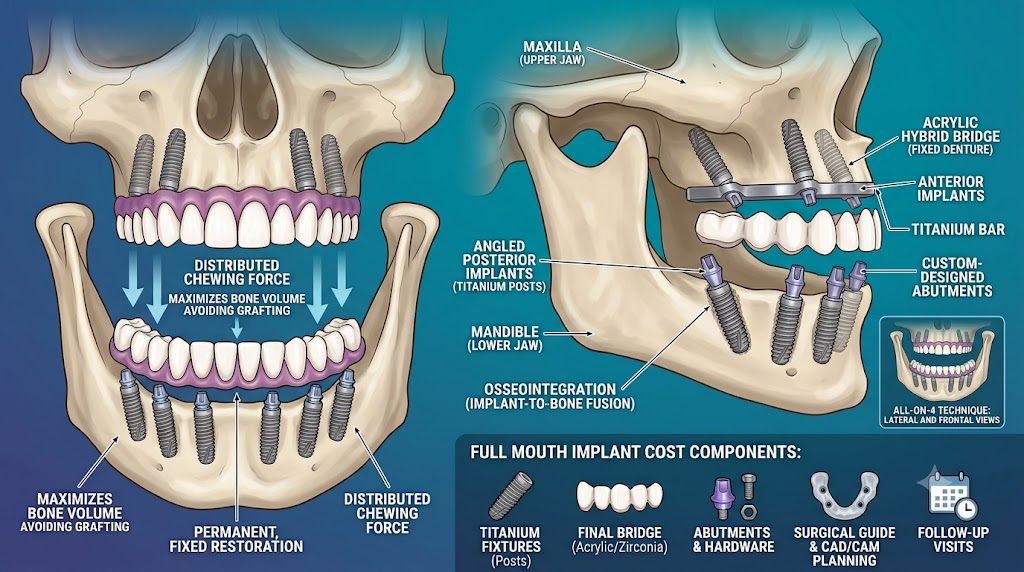
However, full-arch reconstruction is a major medical and financial investment. The total out-of-pocket cost fluctuates considerably based on the surgical protocol selected (such as All-on-4 or All-on-6), the prosthetic materials utilized (acrylic hybrid vs. monolithic zirconia), pre-surgical requirements like bone grafting, and regional clinical pricing.
1. Full Mouth Dental Implant Costs At A Glance
|
Treatment Protocol |
Number of Implants (Per Arch) |
Typical Prosthetic Material |
Average Cost Per Arch |
Full Mouth Cost (Both Arches) |
|---|---|---|---|---|
|
All-on-4 System |
4 Titanium Posts |
Composite / Acrylic Hybrid Bridge |
$14,000 – $24,000 |
$26,000 – $46,000 |
|
All-on-6 System |
6 Titanium Posts |
Acrylic or Porcelain-Fused Metal |
$18,000 – $28,000 |
$34,000 – $54,000 |
|
Full Zirconia Arch |
4 to 6 Titanium/Zirconia Posts |
Monolithic Prettau Zirconia |
$24,000 – $34,000 |
$46,000 – $65,000+ |
|
Implant-Retained Denture (Snap-On) |
2 to 4 Implants |
Removable Acrylic Overdenture |
$7,500 – $13,500 |
$14,000 – $25,000 |
|
Zygomatic Implants |
2 to 4 Cheekbone Implants |
Custom Fixed Zirconia/Titanium |
$28,000 – $38,000 |
$52,000 – $75,000+ |
Note: Fares and pricing ranges represent standard private clinic averages in USD. Costs include surgical placement, abutments, provisional healing teeth, and final permanent prosthetics. Complex bone grafting, sinus lifts, and general anesthesia may incur additional fees.
2. Comparing Full Arch Implant Techniques
All-on-4 Dental Implants
The All-on-4 protocol utilizes four strategically positioned titanium implants per jaw. Two straight anterior implants are placed in the front of the jaw, while two posterior implants are placed at angles up to 45 degrees.
-
Best Suited For: Patients with moderate jawbone loss who wish to avoid extensive bone grafting.
-
Key Advantage: Shorter surgical duration, reduced upfront cost, and the ability to support immediate load provisional teeth (“Teeth in a Day”).
All-on-6 Dental Implants
The All-on-6 technique introduces two additional implants into the posterior molar regions, distributing bite pressure across six anchor points.
-
Best Suited For: Individuals with robust jawbone volume or higher masticatory (chewing) force demands.
-
Key Advantage: Greater biomechanical load distribution and enhanced long-term stability in the event of an individual fixture failure.
Implant-Supported Snap-On Overdentures
A budget-friendly hybrid approach where two to four mini or standard implants feature locator attachments that snap into a removable denture.
-
Best Suited For: Budget-conscious patients seeking improved denture stability over standard adhesives.
-
Key Consideration: The prosthetic must still be removed daily for hygiene maintenance, unlike permanent fixed bridges.
3. Prosthetic Material Comparison: Acrylic vs. Zirconia
The material chosen for the final set of permanent prosthetic teeth plays a substantial role in determining total cost and long-term durability:
|
Feature & Factor |
Acrylic Hybrid on Titanium Bar |
Monolithic Zirconia Bridge |
Porcelain-Fused-to-Metal (PFM) |
|---|---|---|---|
|
Aesthetic Realism |
High |
Superior / Natural Translucency |
High |
|
Stain & Odor Resistance |
Moderate (can absorb stains over time) |
Maximum (non-porous surface) |
High |
|
Chipping / Fracture Risk |
Moderate (teeth may chip, easy repair) |
Extremely Low (virtually unbreakable) |
Moderate (porcelain chipping) |
|
Lifespan Expectancy |
7 to 10 Years before re-lining/refit |
15 to 25+ Years |
10 to 15 Years |
|
Relative Cost Tier |
Mid-Tier Baseline |
Premium (+$4,000 to +$8,000 per arch) |
Mid-to-High Tier |
4. Key Factors Influencing Total Treatment Expenses
-
Preparatory Procedures: Patients suffering from severe periodontal disease or long-term tooth absence may require specialized tooth extractions ($150–$450 per tooth), alveolar bone grafting ($400–$1,200 per site), or sinus lift augmentations ($1,500–$3,500 per side).
-
Diagnostic Imaging & Surgical Guides: Comprehensive treatment planning demands 3D Cone Beam Computed Tomography (CBCT) scanning ($300–$750) and CAD/CAM precision surgical guides ($500–$1,500) to ensure accurate nerve and sinus avoidance.
-
Sedation Modality: While standard local anesthesia is bundled into surgical fees, intravenous (IV) conscious sedation or general hospital anesthesia adds $600 to $2,000 depending on duration.
-
Implant Manufacturer Tier: Industry-leading implant systems backed by decades of clinical trials (e.g., Nobel Biocare, Straumann, Zimmer Biomet) carry higher component fees than generic alternatives.
5. Insurance Coverage & Flexible Financing Options
-
Dental Insurance Realities: Standard dental insurance policies rarely cover the complete cost of full-mouth implants, often capping annual benefits at $1,000 to $2,000. However, plans may cover preparatory tooth extractions, panoramic X-rays, or the denture component of an implant restoration.
-
Medical Insurance Crossovers: In cases where full tooth loss resulted from severe facial trauma, congenital defects, or cancer resections, medical insurance policies may provide partial reimbursement for surgical reconstructions.
-
Healthcare Financing Plans: Third-party medical credit providers (such as CareCredit, Proceed Finance, and LendingClub) offer multi-year payment plans and 0% promotional APR windows to spread full mouth costs into manageable monthly installments.
-
Health Savings (HSA) & Flexible Spending (FSA): Pre-tax HSA and FSA contributions can be directly applied to surgical implant fees, resulting in substantial tax savings.
6. Frequently Asked Questions (FAQs)
What is the average cost of full mouth dental implants in 2026?
A full mouth restoration (both upper and lower jaws) typically ranges from $26,000 to $65,000+, depending on whether All-on-4, All-on-6, or full monolithic zirconia bridges are used.
Why are full mouth dental implants so expensive?
The cost reflects specialized surgical expertise, precision titanium fixtures, custom CAD/CAM laboratory fabrication, 3D diagnostic imaging, and biocompatible materials designed to last decades.
How long do full mouth implants last?
Titanium implant posts integrated into healthy bone can last a lifetime with proper oral hygiene. The prosthetic bridge itself lasts between 10 and 25+ years depending on whether acrylic or zirconia is selected.
Is the All-on-4 procedure painful?
The surgical placement is performed under local anesthesia and IV sedation, making the procedure pain-free. Post-operative discomfort and swelling are generally managed with prescribed medications over 3 to 7 days.
Can you get full mouth dental implants with bone loss?
Yes. Techniques like angled posterior implants (All-on-4), bone grafting, sinus lifts, or zygomatic implants allow patients with significant bone loss to receive permanent fixed teeth.
What is the difference between All-on-4 and snap-on dentures?
All-on-4 is a permanent, fixed bridge screwed into four implants that only a dentist can remove. Snap-on dentures are removable overdentures that click onto implants for stability but must be taken out nightly.
How long is the recovery timeline?
Initial soft-tissue healing occurs in 1 to 2 weeks, while complete bone integration (osseointegration) takes 3 to 6 months before the final permanent zirconia bridge is affixed.
7. Practical Consultation & Treatment Checklist
-
[ ] Schedule a Comprehensive Evaluation: Obtain a high-resolution 3D CBCT scan to evaluate bone density, nerve pathways, and sinus positions.
-
[ ] Request an Itemized All-Inclusive Quote: Verify that your estimate covers extractions, bone grafts, provisional teeth, permanent prosthetics, and follow-up visits.
-
[ ] Inquire About Implant Brand & Warranty: Confirm whether premium, clinically proven implant systems (e.g., Nobel Biocare, Straumann) and prosthetic warranties are included.
-
[ ] Review Prosthetic Material Options: Decide between cost-effective acrylic hybrid bridges and high-durability monolithic zirconia.
-
[ ] Explore Payment & Pre-Tax Accounts: Maximize annual HSA/FSA contributions and verify pre-approval terms with healthcare financing lenders.
Disclaimer: Dental implant pricing, surgical protocols, insurance eligibility, and material longevity vary based on individual physiological conditions and regional dental provider fees. Consult with a board-certified oral surgeon, periodontist, or prosthodontist to receive a personalized diagnostic assessment and treatment plan.