Concrete Crack Repair Techniques: Methods for Different Types of Cracks
Concrete is one of the most durable building materials in modern construction, but it is inherently prone to cracking. Whether in a residential driveway, basement wall, or commercial slab, cracks appear due to the natural tensile stresses concrete experiences over time.
Simply smearing a basic hardware-store caulk or concrete patch over a crack rarely delivers a lasting fix. Effective concrete crack repair requires identifying why the crack formed, determining whether it is actively moving, and selecting a repair material engineered for those specific conditions. Treating every crack identically often leads to repeated repair failures and concealed structural issues.
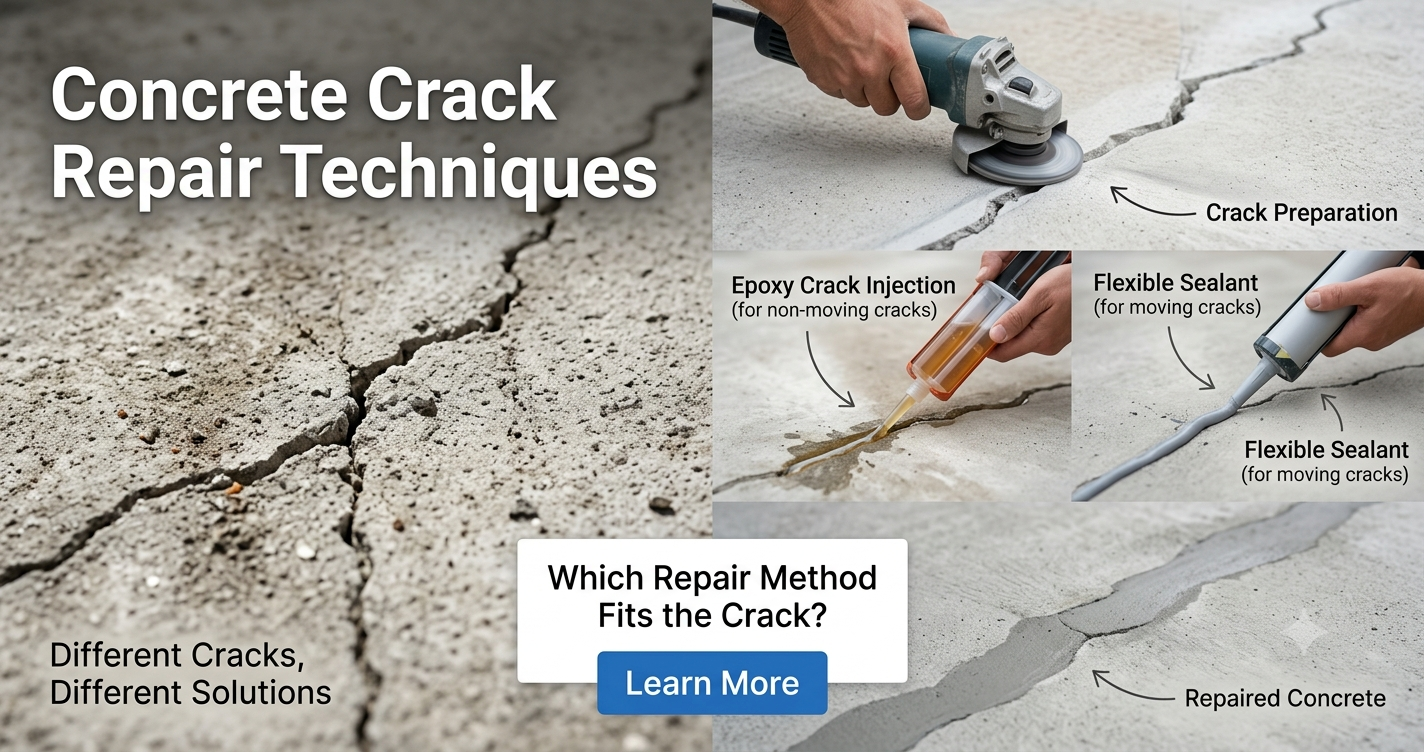
Common Types of Concrete Cracks
Concrete cracks are categorized by their cause, orientation, and potential for ongoing movement.
|
Crack Type |
Possible Cause |
Typical Concern |
General Repair Approach |
|---|---|---|---|
|
Hairline Cracks |
Plastic shrinkage during curing, minor thermal changes |
Primarily cosmetic; can allow early moisture ingress |
High-penetration surface sealers, elastomeric coatings, or low-viscosity treatments |
|
Nonmoving Cracks |
Completed drying shrinkage, historic settling |
Aesthetics, weed growth, water penetration |
Rigid or semi-rigid filling using routing & filling or epoxy |
|
Moving Cracks |
Thermal expansion/contraction, ongoing soil settlement, dynamic loading |
Rigid repair materials will re-crack adjacent concrete |
Flexible joint sealants using routing & sealing |
|
Leaking Cracks |
Water pressure through foundation walls, slabs, or retaining structures |
Basement dampness, efflorescence, rebar corrosion |
Polyurethane (urethane) injection or specialized waterproofing systems |
|
Structural Cracks |
Excessive structural loading, foundation displacement, loss of support |
Load capacity loss, potential safety hazard |
Professional engineering assessment; epoxy injection or structural underpinning |
Note: The appearance of a crack alone cannot conclusively determine its structural stability. Cracks accompanied by displacement or wall bowing require professional evaluation.
Concrete Crack Repair Techniques
Industry guidance identifies several distinct methods for repairing concrete cracks, depending on whether the goal is structural restoration, water-stopping, or simple surface protection.
                         REPAIR METHOD SELECTION
                                   │
         ┌─────────────────────────┴─────────────────────────┐
         ▼                                                   ▼
   MOVING CRACK?                                     NONMOVING CRACK?
         │                                                   │
   ┌─────┴─────┐                                       ┌─────┴─────┐
   ▼           ▼                                       ▼           ▼
Leaking     Dry                                     Structural   Cosmetic
   │           │                                       │           │
   ▼           ▼                                       ▼           ▼
Polyurethane Routing &                              Epoxy        Routing &
Injection   Sealing                                 Injection    Filling
1. Routing and Sealing
This technique is used for non-structural cracks where some movement is expected (such as thermal expansion and contraction in exterior slabs).
-
The Process: A diamond blade router or angle grinder opens the top of the crack along its path, creating a V-shaped or square reservoir (typically 1/4 inch to 1/2 inch wide and deep).
-
Application: After thorough cleaning, a backer rod is inserted if the crack is deep, and a flexible elastomeric sealant (such as polyurethane or silicone sealant) is tooled into the routed joint. This allows the joint to expand and contract without tearing the bond.
2. Routing and Filling
Routing and filling follows a similar surface preparation process to routing and sealing, but uses a rigid or semi-rigid repair material instead of a flexible sealant.
-
The Process: The crack is routed to create a clean channel, brushed clear of all dust, and filled flush with the surface.
-
Application: Suitable for stable, nonmoving cracks on horizontal surfaces where high load transfer or impact resistance is required, such as warehouse floors or residential garage slabs. Materials include semi-rigid polyureas, epoxy mortars, or polymer-modified cementitious repair mortars.
3. Epoxy Crack Injection
Epoxy injection is a precise structural repair method used to weld fractured concrete elements back together.
                       EPOXY INJECTION SETUP
 ┌──────────────────────────────────────────────────────────────┐
 │                      Surface Seal (Cap)                      │
 │   ┌───┐             ┌───┐             ┌───┐             ┌───┐│
 │   │ Ports           │   │             │   │             │   ││
 │───┴─┬─┴─────────────┴─┬─┴─────────────┴─┬─┴─────────────┴─┬─┴│
 │     │  Inject Epoxy   │                 │                 │  │
 │     ▼                 ▼                 ▼                 ▼  │
 │  ░░░░░░░░░░░░░░░░░░░░░░░░░░░░░░░░░░░░░░░░░░░░░░░░░░░░░░░░░░  │
 └──────────────────────────────────────────────────────────────┘
-
The Process: Entry ports are bonded directly over the crack at set intervals along its length, and the surface of the crack between ports is sealed with a fast-curing epoxy paste. High-pressure or low-pressure injection pumps force low-viscosity epoxy resin through the entry ports, working from the lowest port upward until the epoxy penetrates the full depth and length of the crack.
-
Application: Ideal for dormant, structural cracks in basement walls, columns, beams, and foundations where restoring the original tensile and compressive strength of the concrete matrix is required. The concrete surrounding the crack must be clean, sound, and dry for proper adhesion.
4. Polyurethane / Urethane Injection
Polyurethane injection systems are designed primarily for water-stopping and sealing active leaks in concrete structures.
-
The Process: Chemical grout ports (packers) are installed along the crack path. A liquid polyurethane resin is injected under pressure into the crack.
-
Resin Types:
-
Expanding Foams: When the resin encounters water inside the crack, it chemically reacts and expands (up to 20 to 30 times its liquid volume), creating a dense, closed-cell foam seal that stops active water flow within minutes.
-
Flexible Resins: Non-expanding or low-expansion polyurethane resins cure into a flexible, rubber-like gasket that handles slight ongoing movement in the concrete while maintaining a watertight seal.
-
5. Surface Sealers and Protective Coatings
For fine network cracks (crazing) or hairline shrinkage cracks spread across a broad area, individual routing or injection is often impractical.
-
The Process: Penetrating silane/siloxane sealers or high-build elastomeric acrylic coatings are applied over the entire concrete face.
-
Application: Elastomeric coatings can bridge minor hairline cracks that undergo small thermal movements, protecting against water penetration, chloride (salt) ingress, and freeze-thaw damage.
6. Cementitious Crack Repair Materials
Polymer-modified cementitious mortars and hydraulic cements are traditional materials used for patching wider surface defects and nonmoving cracks.
-
The Process: The crack is widened and undercut to lock the cement mortar in place.
-
Application: Polymer-modified mortars offer improved bond strength and reduced shrinkage compared to standard sand-and-cement mixes. They work best on horizontal or vertical nonmoving concrete surfaces where structural bonding is not required.
How to Choose the Right Repair Method
To select an effective repair strategy, systematically evaluate the crack using this simple decision workflow:
┌─────────────────────────────────────────────────────────────────┐
│                    CRACK EVALUATION FLOWCHART                   │
└────────────────────────────────────────┬────────────────────────┘
                                         │
                                         ▼
                       ┌──────────────────────────────────┐
                       │  Is structural failure or active │
                       │  foundation movement suspected?  │
                       └─────────────────┬────────────────┘
                                         │
                       ┌─────────────────┴─────────────────┐
                      YES                                  NO
                       │                                   │
                       ▼                                   ▼
          ┌─────────────────────────┐     ┌──────────────────────────────────┐
          │ Stop. Consult a licensed│     │   Is water actively leaking or   │
          │ structural engineer.    │     │   seeping through the crack?     │
          └─────────────────────────┘     └────────────────┬─────────────────┘
                                                           │
                                         ┌─────────────────┴─────────────────┐
                                        YES                                  NO
                                         │                                   │
                                         ▼                                   ▼
                            ┌─────────────────────────┐     ┌──────────────────┐
                            │ Use Polyurethane Chemical│     │ Is the crack     │
                            │ Injection system.       │     │ active/moving?   │
                            └─────────────────────────┘     └────────┬─────────┘
                                                                     │
                                                   ┌─────────────────┴─────────┐
                                                  YES                          NO
                                                   │                           │
                                                   ▼                           ▼
                                      ┌────────────────────────┐  ┌────────────────────────┐
                                      │ Use Routing & Sealing  │  │ Use Epoxy Injection,   │
                                      │ with flexible sealant. │  │ Routing & Filling, or  │
                                      └────────────────────────┘  │ Cementitious Mortars.  │
                                                                  └────────────────────────┘
Basic Concrete Crack Repair Process
Regardless of the specific repair material chosen, successful application follows a standard step-by-step workflow:
-
Inspect and Document: Examine the crack width, depth, orientation, and moisture condition. Determine if the crack is active (growing or moving) or dormant (stable).
-
Identify Underlying Causes: Address contributing issues such as poor drainage, clogged gutters, tree root pressure, or overload before applying repair products.
-
Clean and Prepare the Substrate: Remove loose concrete, laitance, oil, and dust. Mechanical preparation (grinding, routing, or wire brushing) is often necessary to expose sound concrete.
-
Mix Materials Accurately: Two-component repair products (such as epoxies and polyurethanes) require strict mixing ratios and adherence to published “pot life” (working time) limits.
-
Apply Compatible Material: Install the chosen material using appropriate tools (caulking gun, injection pump, trowel, or squeegee) according to manufacturer instructions.
-
Allow Proper Cure: Protect the repair area from traffic, moisture, and extreme temperatures during the full curing cycle specified by the product manufacturer.
-
Monitor the Repair: Inspect the repaired crack periodically to verify that the bond remains intact and no secondary cracking develops adjacent to the repair zone.
Surface Preparation: The Most Critical Step
The primary cause of concrete repair failure is improper surface preparation. Concrete repair materials must achieve a strong mechanical or chemical bond with the host substrate.
┌─────────────────────────────────────────────────────────────────┐
│               SURFACE PREPARATION REQUIREMENTS                  │
├───────────────────┬─────────────────────────────────────────────┤
│ Sound Substrate   │ Chisel away weak, spalling, or micro-cracked│
│                   │ concrete until reaching solid aggregate.    │
├───────────────────┼─────────────────────────────────────────────┤
│ Cleanliness       │ Remove oil, grease, dirt, moss, and old     │
│                   │ paint using wire brushes or degreasers.     │
├───────────────────┼─────────────────────────────────────────────┤
│ Dust Removal      │ Vacuum out fine silica dust from deep       │
│                   │ within the crack using oil-free compressed  │
│                   │ air or a HEPA vacuum.                       │
├───────────────────┼─────────────────────────────────────────────┤
│ Moisture Status   │ Ensure the surface profile matches the      │
│                   │ product spec (Dry, Damp-proof, or Wet).     │
└───────────────────┴─────────────────────────────────────────────┘
Warning: Never apply epoxy injection resins over wet or dirty concrete surfaces unless the specific product is explicitly rated for wet-bond applications.
When DIY Repair May Be Reasonable
DIY repair is suitable for minor surface issues that do not threaten structural stability:
-
Narrow, nonmoving hairline cracks in garage floors, patios, or walkways
-
Cosmetic surface crazing on concrete slabs
-
Static horizontal cracks where water intrusion is not a factor
-
Surface patching using straightforward, consumer-grade elastomeric caulks or acrylic fillers
When to Call a Professional
Contact a qualified structural engineer or professional concrete repair contractor if you observe any of the following warning signs:
-
Wide or Rapidly Expanding Cracks: Cracks that open significantly or widen continuously over short periods.
-
Differential Displacement (Shearing): One side of the crack is noticeably higher or offset from the other side, indicating soil settlement or slab displacement.
-
Diagonal or Stair-Step Cracks: Diagonal cracking near wall corners or stair-step cracks in concrete block foundations often signal differential foundation settlement.
-
Corrosion and Spalling: Cracks accompanied by rust staining, flaking concrete, or exposed, corroded steel reinforcement bars (rebar).
-
Structural Wall Bowing: Foundation walls leaning inward or bulging under lateral hydrostatic soil pressure.
-
Persistent Water Intrusion: Continuous water flow through foundation walls that cannot be resolved with basic surface drainage fixes.
Common Concrete Crack Repair Mistakes
-
Filling a Moving Crack with Rigid Epoxy: Forcing a rigid structural epoxy into an active expansion joint or moving settlement crack forces the concrete to relieve stress by forming a new crack right next to the repair.
-
Ignoring the Root Cause: Patching a basement wall crack without correcting poor yard grading or clogged footing drains will lead to recurring water pressure failures.
-
Failing to Remove Dust: Applying liquid sealants into an un-vacuumed, dusty crack causes the material to adhere to the loose dust particles rather than the concrete wall, leading to rapid debonding.
-
Over-smoothing / Feather-Edging: Applying thin “feather edges” of standard cement mortar over a crack edge leads to chipping; proper repairs require square-cut edges or routing.
-
Misinterpreting Injection Pressures: Injecting polyurethane or epoxy resins under excessive pressure can rupture weak basement walls or blow off surface seals.
Concrete Crack Repair vs. Concrete Resurfacing
It is important to distinguish between targeted crack repair and full-surface concrete restoration:
┌─────────────────────────────────────────────────────────────────┐
│             REPAIR vs. RESURFACING vs. REPLACEMENT              │
├───────────────────┬─────────────────────────────────────────────┤
│ Crack Repair      │ Isolated treatment of individual cracks     │
│                   │ to restore continuity or prevent leaks.     │
├───────────────────┼─────────────────────────────────────────────┤
│ Concrete          │ Application of a thin polymer overlay across│
│ Resurfacing       │ an entire slab to refresh worn surfaces     │
│                   │ containing widespread cosmetic cracking.    │
├───────────────────┼─────────────────────────────────────────────┤
│ Full Slab         │ Demolishing and pouring new concrete when   │
│ Replacement       │ structural degradation or severe displacement│
│                   │ affects more than 25-30% of the surface.    │
└───────────────────┴─────────────────────────────────────────────┘
Note: All underlying active cracks must be repaired and honored (e.g., mirrored through control joints) before applying a decorative concrete resurfacing overlay, or the cracks will reflect through the new finish.
Frequently Asked Questions
What is the best way to repair cracks in concrete?
There is no single “best” method. The ideal technique depends on crack movement and moisture: routing and sealing works best for moving exterior cracks, epoxy injection is ideal for dry structural repairs, and polyurethane injection is best for sealing active water leaks.
Is epoxy good for concrete cracks?
Epoxy is excellent for dormant, nonmoving structural cracks where high bonding strength is required to restore original concrete integrity. It should not be used on active expansion joints or wet cracks unless specifically formulated for those conditions.
Should concrete cracks be filled or sealed?
Structural cracks in dry concrete are generally filled with rigid materials (like epoxy) to restore load transfer. Cracks that undergo ongoing thermal or soil movement should be sealed using flexible elastomeric sealants to accommodate movement without tearing.
What is the difference between epoxy and polyurethane crack repair?
Epoxy cures into a hard, rigid plastic that restores structural strength to nonmoving concrete. Polyurethane cures into a flexible elastomer (or expanding foam) that stops water leaks and accommodates minor concrete movement, but does not provide structural bonding strength.
Can hairline cracks in concrete be repaired?
Yes. Fine hairline cracks can be treated using ultra-low-viscosity epoxy resins, penetrating silane/siloxane sealers, or elastomeric surface coatings that seal the surface against water and salt ingress.
How do you repair a moving concrete crack?
Route the top of the crack to form a clean, uniform channel, clean out all debris, install a foam backer rod at the base of the channel, and tool a high-performance elastomeric sealant (such as polyurethane or silicone) flush with the surface.
Can concrete crack filler stop water?
Standard topical concrete fillers generally fail under hydrostatic water pressure. To stop active water leaks through foundation walls, professional polyurethane foam injection systems are recommended.
When is a concrete crack considered serious?
A crack is generally considered serious if it shows significant horizontal or vertical offset (shearing), opens rapidly over time, is accompanied by bowing walls, or threatens structural support components.
Can I repair concrete cracks myself?
Homeowners can repair minor, non-structural cosmetic cracks in driveways, patios, and garage floors using consumer-grade flexible sealants or patch mortars. Structural cracks, leaking basements, or foundation settlement issues should be evaluated by a professional.
Why do repaired concrete cracks sometimes come back?
Repaired cracks often reappear if the underlying cause (such as foundation settlement, freeze-thaw pressure, or thermal movement) was not addressed, or if a rigid repair material was applied to an active, moving crack.