3 College Degrees That May Be Worth the Cost in 2026
Evaluating higher education expenses in 2026 requires looking beyond campus marketing materials to weigh the long-term impact of student loan debt and college outcomes. The conversation around higher education has shifted away from whether a degree is valuable in the abstract, focusing instead on college degree ROI—measuring a program’s cost against realistic career opportunities and median early-career earnings.
No undergraduate program guarantees immediate financial success or a high-paying job. However, national employment tracking from the U.S. Bureau of Labor Statistics (BLS) and data from the U.S. Department of Education’s College Scorecard show that certain degree fields consistently offer degrees with strong job prospects and solid early-career earning power.
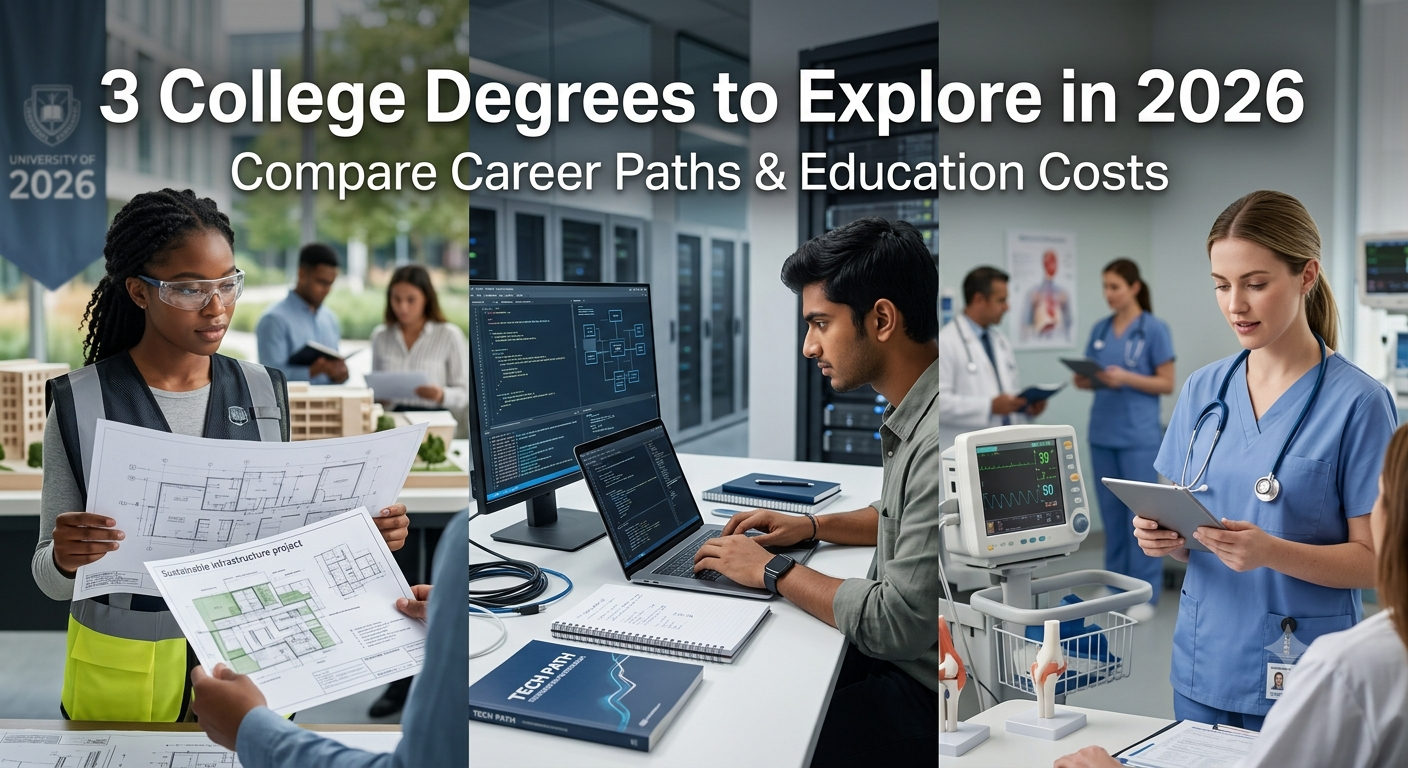
Why the Cost of a Degree Matters
A degree’s financial impact depends on total net price rather than listed sticker price. Tuition, room, board, and accumulated interest on loans determine your starting baseline.
Taking on $80,000 in debt for a degree field where average entry-level roles pay $40,000 creates severe financial friction. Conversely, borrowing $25,000 for a degree yielding $70,000 in entry-level earnings provides manageable repayment terms and flexibility for future financial goals.
How to Evaluate College Return on Investment
Evaluating college degrees worth the cost in 2026 involves looking past general university rankings to examine program-specific data:
-
Net Price vs. Sticker Price: Subtract non-repayable aid (grants and scholarships) from total costs to calculate your actual out-of-pocket obligation.
-
Program-Level Median Earnings: Compare expected starting salaries for your specific major at your institution, rather than relying on institution-wide averages.
-
Completion and Graduation Rates: A degree only delivers ROI if finished; dropping out with debt but no credential yields the worst outcome.
-
The “1-to-1 Debt Rule”: Keep total cumulative student debt at or below your expected first-year starting salary to maintain manageable monthly payments.
Degree #1: Engineering and Related Fields
Engineering fields—including Mechanical, Electrical, Chemical, and Civil Engineering—remain among the highest-earning undergraduate majors.
┌─────────────────────────────────────────────────────────────┐
│                 ENGINEERING DEGREE PATHWAYS                 │
├──────────────────────────────────────┬──────────────────────┤
│ Core Skillset                        │ Key Career Advantage │
├──────────────────────────────────────┼──────────────────────┤
│ Applied physics, calculus, system    │ Immediate entry into │
│ design, and structural analysis      │ high-demand roles    │
└──────────────────────────────────────┴──────────────────────┘
-
Career Opportunities: Engineering graduates enter fields like infrastructure design, clean energy manufacturing, aerospace systems, and automation.
-
Educational Path: A four-year Bachelor of Science (B.S.) degree is typically the primary entry requirement for professional roles.
-
Cost vs. Outcome: While laboratory-intensive engineering programs can carry high tuition rates, early-career median salaries often range between $70,000 and $85,000. This starting point makes manageable debt levels relatively easy to service.
Degree #2: Health Professions and Healthcare
Healthcare offers strong employment stability and includes some of the fastest-growing occupations tracked by the U.S. Bureau of Labor Statistics.
-
Career Opportunities: Registered Nurses (RNs), Medical and Health Services Managers, Radiologic Technologists, and Diagnostic Sonographers experience sustained labor demand across both urban and rural markets.
-
Educational Path: Options range from two-year Associate Degrees in Nursing (ADN) to four-year Bachelor of Science in Nursing (BSN) programs and administrative healthcare degrees.
-
Cost vs. Outcome: BSN graduates enjoy strong job security and median starting salaries often exceeding $75,000. Additionally, many healthcare employers offer tuition reimbursement programs for staff pursuing advanced credentials.
Note: While advanced clinical roles (such as Nurse Practitioners or Physicians) require post-graduate education, starting with a BSN allows graduates to enter the workforce quickly and minimize undergraduate debt.
Degree #3: Computing, Technology, and Data Science
The technology sector remains a major driver of bachelor’s-level recruitment, with focused demand in cybersecurity, data analytics, and software infrastructure.
-
Career Opportunities: Key entry-level paths include Software Developer, Information Security Analyst, Data Scientist, and Systems Administrator.
-
Educational Path: A Bachelor of Science in Computer Science, Information Technology, or Data Analytics provides the theoretical foundation and practical coding skills employers require.
-
Cost vs. Outcome: Entry-level technical positions frequently offer starting salaries ranging from $70,000 to $90,000+. However, practical portfolios, internships, and technical demonstrations carry substantial weight alongside the physical degree during hiring decisions.
Comparing Top 2026 Degree Fields
|
Degree Field |
Typical Career Paths |
Education Requirements |
Potential Cost Factors |
Key ROI Considerations |
|---|---|---|---|---|
|
Engineering |
Mechanical, Electrical, Civil Engineer |
Bachelor of Science (B.S.) |
Lab fees, specialized software, 4-year tuition |
High starting salary offers manageable debt repayment. |
|
Health Professions |
Registered Nurse (RN), Health Services Manager |
ADN (2-yr) or BSN (4-yr) |
Clinical placement costs, licensure exam fees |
Strong job stability and broad employer tuition assistance. |
|
Computing & Tech |
Software Developer, Security Analyst, Data Scientist |
Bachelor of Science (B.S.) |
High university tech fees; constant skill updates |
Solid starting pay, though portfolio & internships are vital. |
How Student Loans Can Affect Career ROI
Taking on excessive debt changes your career trajectory. High monthly loan payments can force graduates to take the first available job rather than waiting for an ideal professional fit, delay major milestones like buying a home, or prevent saving for retirement.
Total Debt > Expected 1st-Year Salary  ──►  High Repayment Strain & Risk
Total Debt ≤ Expected 1st-Year Salary  ──►  Manageable Repayment & Flexibility
Even in high paying college degrees, over-borrowing at private interest rates significantly lowers the net return on your educational investment.
Questions to Ask Before Borrowing for College
-
What is the specific net price to complete this program at this university after applying non-repayable aid?
-
What are the program-level median starting earnings for recent graduates at this specific institution?
-
What percentage of students enrolled in this major complete their degree on time?
-
Will I need a graduate degree or additional certifications before I can earn a competitive salary in this field?
-
How does my projected monthly loan payment compare to my expected monthly post-tax income?
Alternatives to High-Debt Educational Paths
You do not need to accumulate six-figure debt to secure strong best majors for career opportunities:
-
The 2+2 Community College Route: Complete general education coursework at an accredited community college before transferring to a four-year state university to halve your tuition costs.
-
Registered Apprenticeships: Programs in technical trades, advanced manufacturing, and specialized IT offer paid, hands-on training alongside technical instruction.
-
Employer-Sponsored Education: Secure an entry-level position with an organization that offers tuition assistance to complete your degree while working.
-
In-State Public Universities: Opting for an in-state public institution over an out-of-state private college frequently saves tens of thousands of dollars in overall tuition.
FAQ
Which college degrees have the best ROI?
Engineering, computer science, nursing, and quantitative business fields (like finance and accounting) consistently yield strong ROI due to high initial earnings and sustained workforce demand.
Is college worth the cost in 2026?
College remains a valuable investment when total borrowing is kept reasonable relative to projected earnings, the student finishes the program, and the chosen field exhibits steady growth.
Which degrees lead to high-paying careers?
Technical degrees in engineering, computing, data science, and quantitative finance generally lead directly to high entry-level compensation.
How much student debt is too much?
A reliable guideline is keeping cumulative federal and private borrowing at or below your anticipated first-year gross starting salary.
Should students choose a major based on salary?
Salary is an important factor, but choosing a major purely for earnings potential can lead to burnout if you lack aptitude or interest in the subject matter.
How can students reduce college borrowing?
Students can lower debt by applying for institutional grants, completing general education credits at community colleges, living at home, or working part-time.
Are community colleges a more affordable option?
Yes. Community colleges offer lower credit-hour costs, allowing students to earn associate degrees or complete transfer pathways at a fraction of university rates.
How can I compare colleges for return on investment?
Use free tools like the U.S. Department of Education’s College Scorecard to check median debt, completion rates, and post-graduation earnings by major and institution.
Conclusion
A degree’s true value depends on your choice of major, overall borrowing, and institutional costs. By examining best college degrees 2026 data, minimizing reliance on student loans, and targeting in-demand sectors, students can earn a valuable credential without compromising their long-term financial security.
Disclaimer: Earnings figures, employment projections, and debt levels reflect median national averages and estimates based on U.S. Bureau of Labor Statistics and College Scorecard reporting. Individual outcomes vary based on geographic region, institutional choice, economic conditions, personal effort, and external market factors.